
How to Choose the Best Online Casinos for Canadian Players

Route recap
Canadian players face a licensing patchwork, not a single national rulebook. Ontario runs its own regulated market; the Kahnawake Gaming Commission has licensed offshore operators since the late 1990s; and a large share of Canada-facing sites operate under the Malta Gaming Authority. Which regulator stands behind a casino changes what happens when a payout stalls or a bonus term turns out to be worse than advertised. This guide walks through six essential checks to separate a licensed operator from a well-designed landing page: who regulates it, who tests its games, how money moves, what the bonus math really costs, how disputes escalate, and what support you can reach at 3 a.m.
Licensing and Regulatory Compliance
The first thing to establish is which regulator issued the licence, because that determines your entire recourse path if something goes wrong. Canada does not have one national online casino regulator. It has three distinct structures that matter to players.
Ontario is the only province with a competitive private online gaming market. It launched on April 4, 2022, making Ontario the first Canadian province to open regulated online gambling to private operators. The structure is deliberately two-step. An operator must first be registered by the AGCO, which determines eligibility and registers igaming operators and suppliers, and can only then execute a separate operating agreement with iGaming Ontario before legally offering games to Ontario players. Registration and operation are separate approvals. A site claiming to be “Ontario licensed” without naming both steps is describing half the process.
Outside Ontario, the Kahnawake Gaming Commission is the longest-running option. Established June 10, 1996 under the Kahnawake Gaming Law, it has continuously licensed and regulated online gaming since July 8, 1999, making it one of the oldest online gambling regulators in the world.
That longevity matters for a practical reason.
The Commission has a codified complaints process and a full-time Dispute Resolution Officer, which most newer regulators do not.
The third common licence is the Malta Gaming Authority. The MGA’s stated mission is to regulate gaming under its remit by ensuring it is fair and transparent, preventing crime, and protecting minors and vulnerable players. MGA-licensed operators are commonly seen serving Canadian players from outside Ontario’s regulated market. The MGA is a national regulator with a real enforcement record, but it sits outside Canadian jurisdiction, so escalation runs through Malta, not a provincial body.
This has practical implications. Check the licence footer, then verify the licence number on the regulator’s own site. A licence claim you cannot verify on the regulator’s register is not a licence claim.
Game Selection and Software Providers
Game count is a marketing number. The number that matters is who tested the random number generator, because that is what makes the games fair rather than merely varied.
Three independent labs do most of this work. GLI (Gaming Laboratories International) is an independent testing, inspection and certification body that verifies RNGs for fairness and unpredictability and certifies gaming products against GLI standards and individual jurisdictional requirements across hundreds of jurisdictions worldwide. eCOGRA provides RNG testing, game payout and RTP review, and ongoing monitoring, and also evaluates operator conduct such as player-fund handling and responsible-gambling implementation. iTech Labs is an internationally recognized independent lab that certifies RNG fairness, RTP accuracy, and bonus-mechanic functionality — though that detail comes from a third-party industry explainer rather than iTech Labs’ own site, so treat the specific scope as approximate.
RTP is the number players actually argue about. Return to Player is the percentage of all money wagered on a casino game that is mathematically designed to be paid back to players over the long term, calculated over millions of spins rather than as a short-term guarantee. The complement of RTP is the house edge. A game with 96% RTP carries a 4% house edge, while lower-RTP games carry correspondingly higher house edges. Online slot games generally publish RTPs in the range of roughly 95% to 98%, per eCOGRA’s own explainer.
Two things follow from that. First, RTP is a long-run average, not a session prediction. Even a high-RTP game can pay nothing for an hour. Second, a lower-RTP game is not rigged; it is priced differently. The useful check is whether the operator publishes per-game RTP at all, and whether the testing lab is named. If you play mostly on your phone between commutes, the same RTP and testing standards apply. a Canada mobile casino guide is worth reading alongside this section if mobile play is your default.
Banking Options for Canadian Players
Interac e-Transfer dominates Canadian online casino deposits, and the reason is structural rather than promotional. It moves funds via direct bank-to-bank transfer rather than through a card network, and it is supported by 250+ Canadian banks and credit unions. Critically, banking credentials are not shared with the casino; only a payment notification passes between the parties. This matters for security. The casino never holds your online banking login.
The dominance claim itself comes from Canadian gambling-industry publications rather than an official Interac Corp. statistic, so treat “most popular” as a strong industry consensus rather than a measured figure. The mechanism itself is straightforward. It works bank-to-bank, with no card network in the middle and no credentials handed over.
Card deposits still exist and still work, but they route through a card network, which means chargeback rules and foreign-transaction fees can apply depending on the issuer. For players who want the deposit to look like a normal bank transfer rather than a gambling transaction on a statement, e-Transfer is the cleaner path.
Withdrawal speed is where operators differentiate, and it is worth checking the stated window before depositing rather than after winning. A site that advertises instant deposits but a multi-day withdrawal window is telling you where its priorities sit.
Bonus Terms and Wagering Requirements
The headline bonus number is the least important number on the page. The wagering requirement is the one that determines whether you ever see the money.
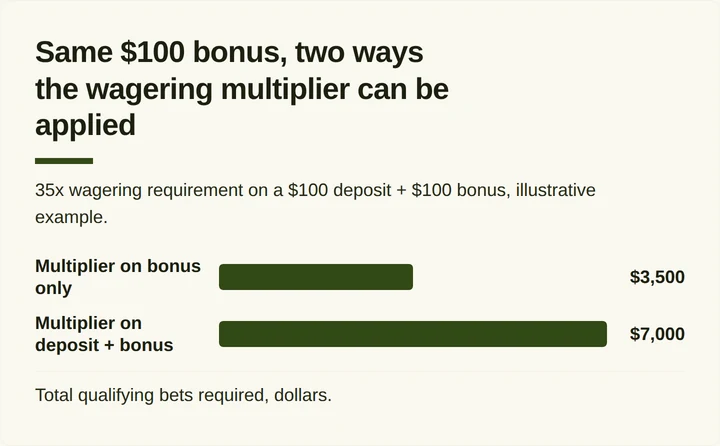
The math is simple once you have the multiplier. A $100 bonus with a 35x wagering requirement, applied to the bonus amount only, requires $3,500 in total qualifying bets before the bonus funds become withdrawable. The formula is bonus amount multiplied by the wagering multiple. That $3,500 is not a fee. It is turnover you have to generate, and every bet along the way carries the house edge.
The trap is what the multiplier applies to. Some operators apply it to deposit plus bonus combined rather than to the bonus alone. On the same $100 deposit and $100 bonus at 35x, that doubles the requirement from $3,500 to $7,000. Two operators can advertise “35x wagering” and mean materially different things.
Three other terms change the real cost. These are game weighting (slots often count 100% toward wagering, table games frequently count far less), maximum bet limits while a bonus is active, and expiry windows. A bonus that expires in seven days at a $5 max bet is a different product from one with thirty days and no cap.
Read the terms before opting in, not after. Most disputes about bonuses arise from confusion about weighting and expiry, which were disclosed in the terms but skipped in the reading.
Security and Player Protection
Licensing and testing answer different questions. The licence tells you who has jurisdiction over the operator. The testing tells you whether the games behave as advertised. Security sits at the intersection of the two, and ties directly into what makes an online casino safe and reliable. It is what happens when both are enforced together.
On the technical side, RNG certification from GLI, eCOGRA, or iTech Labs is the baseline. An RNG that has been verified for fairness and unpredictability means the outcome of a spin is not influenced by bet size, account history, or session length. That is a testable claim, and the labs that make it are independent of the operators they certify.
On the audit side, eCOGRA’s remit extends beyond RNGs to include operator conduct: player-fund handling and responsible-gambling implementation. This is a different kind of check from RNG testing, examining whether player money is segregated and whether the operator’s responsible-gambling tools actually function.
On the regulatory side, the licence determines whether there is an enforcement body with teeth. The AGCO registers Ontario operators and can act on regulatory complaints. The Kahnawake Gaming Commission has maintained a dispute process for over two decades. The MGA operates under a statutory mandate covering fairness, crime prevention, and protection of minors and vulnerable players.
Encryption and account security are table stakes and largely undifferentiated between licensed operators. The differentiator is whether the operator’s security claims are backed by an independent audit you can verify, or by a padlock icon and a paragraph of marketing copy.
Customer Support Quality
Round-the-clock live chat is the baseline among top-tier regulated online casinos, commonly supplemented by email and phone support. That is an industry-publication norm rather than a regulator-mandated requirement, but it is a useful filter. An operator without around-the-clock chat is either under-resourced or not targeting the market seriously.
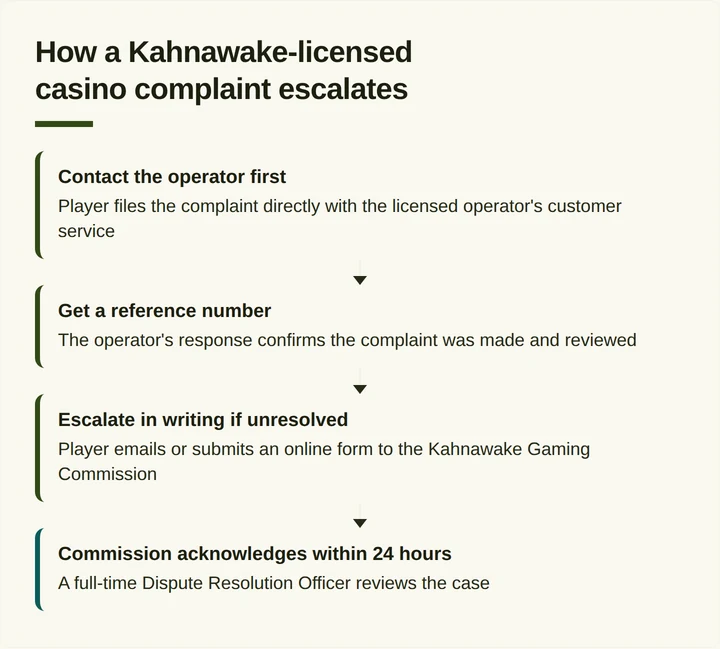
Support quality matters most in the specific moment a complaint starts. Both major regulators require the same first step. Contact the operator directly. In Ontario, a player must first file a complaint with the registered operator’s customer service and obtain a complaint or reference number. Unresolved complaints escalate to the AGCO (which handles regulatory complaints), unless they fall into special categories like responsible gambling, suspected illegal activity, or advertising. Meanwhile, iGaming Ontario separately runs a dispute-resolution process operators must participate in.
The Kahnawake path is similar in shape. The Commission requires player complaints to first be submitted to the licensed operator for review. If unresolved, players can escalate in writing to the Commission, which acknowledges complaints within 24 hours and has a full-time Dispute Resolution Officer. The process is codified in the Commission’s Regulations concerning Interactive Gaming, Part XXIV, sections 267 to 281.
The practical takeaway is straightforward.
Get the reference number.
Without it, you have no record that you tried the operator’s process first, and both regulators treat that step as a precondition rather than a formality.
Conclusion
Choosing a Canadian online casino is a verification exercise, not a comparison of welcome offers. The six checks in this guide form a sequence you can follow. Confirm which regulator issued the licence and verify it on the regulator’s register. Confirm which independent lab tested the RNG and whether per-game RTP is published. Check that the banking method does not require handing over credentials. Read the wagering terms for what the multiplier applies to, not just its size. Confirm the operator’s security claims are backed by an independent audit. Confirm round-the-clock support exists with a documented escalation path.
What changes for a player who runs these checks is not the odds. It is the recourse. A player who knows their operator is AGCO-registered and iGaming Ontario-contracted knows exactly where an unresolved complaint goes. A player who knows their operator holds a Kahnawake licence knows the Commission acknowledges complaints within 24 hours and has a Dispute Resolution Officer. A player who verified the RNG lab knows the fairness claim is testable rather than asserted.
The alternative — picking on bonus size and site design — leaves you with no verified regulator, no named testing lab, and no escalation path. That is the actual cost of skipping the checks, and it does not show up until the first withdrawal that does not arrive.
FAQ
Which regulator oversees online casinos in Ontario? Two bodies, in sequence. The AGCO registers igaming operators and suppliers and determines eligibility. Once registered, an operator must execute a separate operating agreement with iGaming Ontario before it can legally offer games to Ontario players. Ontario’s regulated market launched April 4, 2022.
What is the Kahnawake Gaming Commission? A regulator established June 10, 1996 under the Kahnawake Gaming Law, licensing and regulating online gaming for over two decades. It is one of the longest-running online gambling regulators in the world and maintains a full-time Dispute Resolution Officer.
What does RTP actually mean? Return to Player is the percentage of all money wagered that a game is mathematically designed to pay back over the long term, calculated across millions of spins. It is not a short-term guarantee. The complement of RTP is the house edge. A high-RTP game carries a correspondingly lower house edge. Online slots generally publish RTPs in the roughly 95% to 98% range.
Why is Interac e-Transfer so common for Canadian players? It moves funds via direct bank-to-bank transfer rather than a card network, and banking credentials are not shared with the casino — only a payment notification passes between the parties. Industry publications describe it as the most popular method in Canada, supported by 250+ banks and credit unions.
How do I escalate a complaint if the casino won’t resolve it? Contact the operator first and get a complaint or reference number. Both the AGCO and the Kahnawake Gaming Commission require this initial step. In Ontario, unresolved complaints then escalate to the AGCO, with iGaming Ontario running a separate dispute-resolution process. For Kahnawake-licensed operators, unresolved complaints escalate in writing to the Commission, which responds quickly.