
Comparing Modern Online Casino Platforms

Route recap
The meaningful comparison examines which business model sits underneath the lobby, because the model determines how games get certified, how bonuses are structured, how fast withdrawals clear and how much of the operation is outsourced. Three shapes dominate. Vertically integrated operators build and license their own stack, white-label platforms rent a ready-made casino from a supplier, and aggregator-fronted sites assemble content through a single distribution API. Each shape produces a different player experience at the same headline bonus.
Three platform models, three different risk profiles
A vertically integrated operator controls its own gaming licence, its own wallet and its own game-integration layer. That means one company is accountable for the RNG certification, the payment rails and the support desk. The tradeoff is cost. This model needs compliance staff, lab audit fees and payment integrations in every market it enters, so it tends to launch in fewer jurisdictions and scale slowly.
White-label platforms invert that. The supplier holds the platform licence and the technology; the brand rents both and supplies marketing. White-label launches are faster than building an integrated platform from scratch. The brand often does not control withdrawal queues, so a slow payout usually traces back to the supplier’s own process. Aggregators sit in a third position, distributing game content from multiple studios through one integration. A mid-size site can therefore show thousands of titles without signing each studio separately. Aggregation shortens the content pipeline and lengthens the dependency chain.
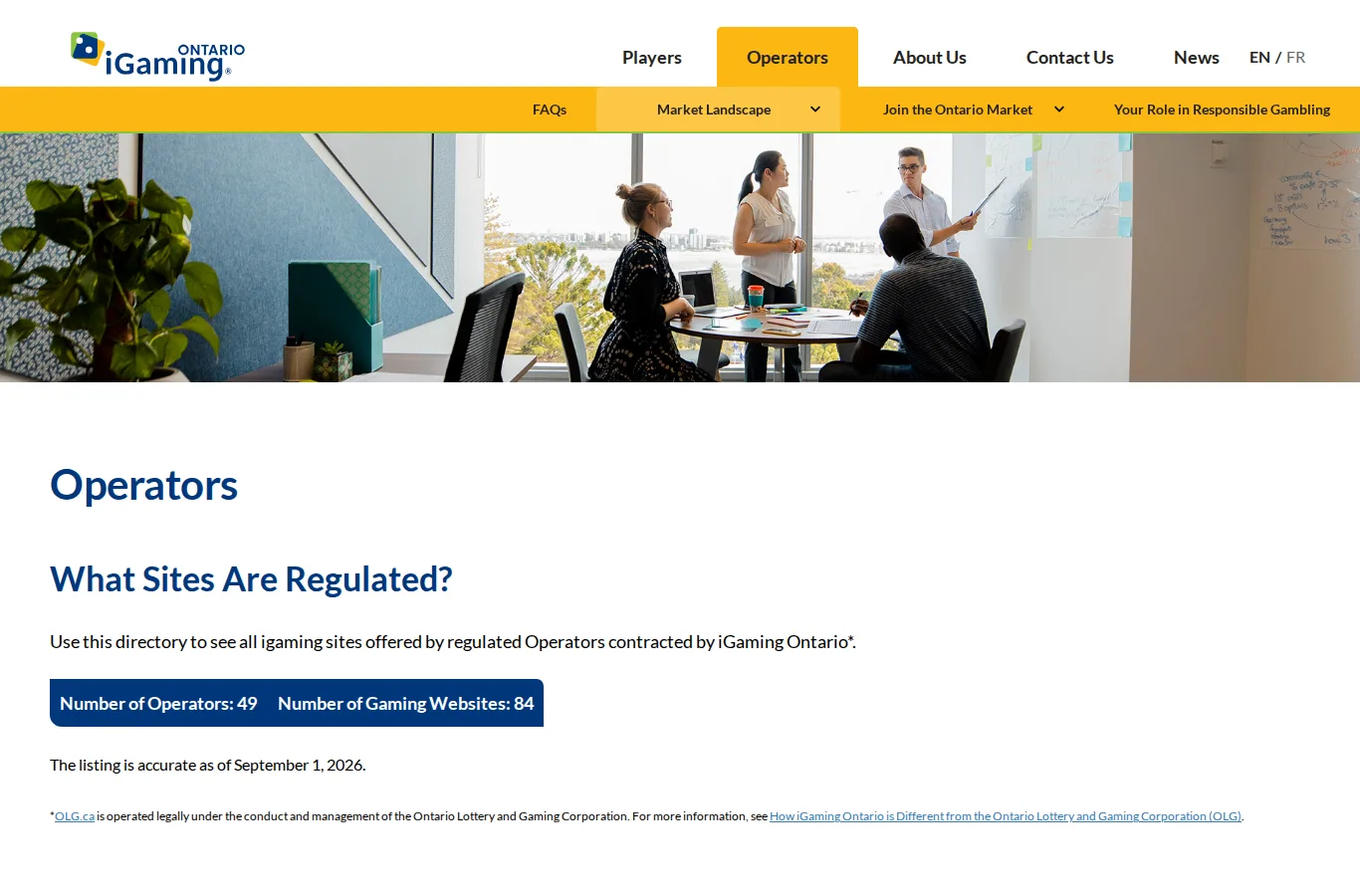
Ontario shows how quickly the licensed layer has scaled under this mix. iGaming Ontario’s operator directory listed 49 licensed operators as of September 2026. Together, those operators run 84 approved gaming websites, all regulated by the AGCO.
Accountability sits in different places depending on platform type. On an integrated operator, one complaint route covers everything. On a rented platform, the brand can escalate but cannot rewrite the payout process.
How RNG certification actually works
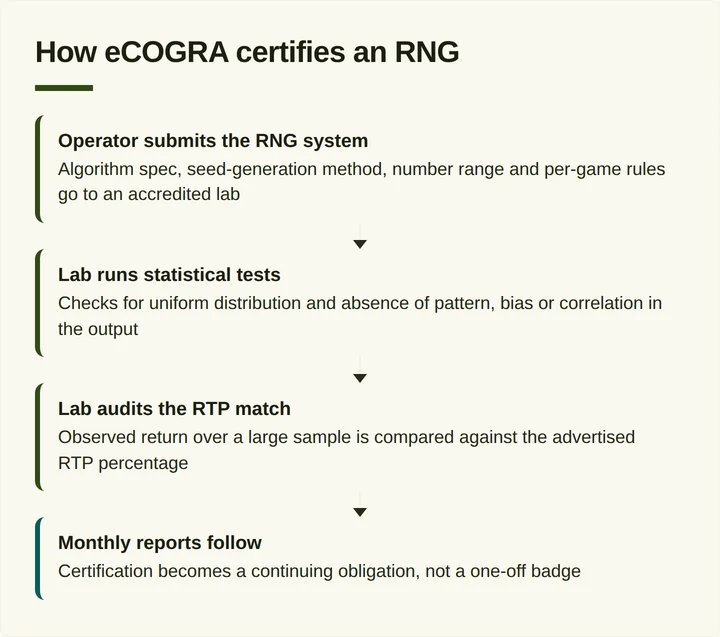
Certification is not a badge a casino buys. It is a lab re-running the random number generator against a large sample and comparing the output to the advertised return-to-player figure. The mechanism runs in two stages. First, the operator or developer submits the RNG system to an accredited lab with technical documentation. This includes the algorithm specification, the seed-generation method, the number range and the per-game rules. The lab then runs statistical tests for uniform distribution and checks for pattern, bias or correlation in the output. Second, and separately, the lab audits whether the observed return over a large sample matches the RTP percentage the game advertises. A game whose measured return falls meaningfully short of its advertised figure fails this check, regardless of how clean the distribution looks.
eCOGRA publishes monthly reports for operators it has certified after that initial certification, which turns a one-off audit into a continuing obligation. RTP figures on certified games become testable, checkable claims. A platform that cannot produce a current certification report is asking players to take the number on trust.
Game library size versus game library quality
Library size is the easiest metric to inflate and the least useful on its own. A lobby with 8,000 titles assembled through an aggregator may contain fewer distinct maths models than a 1,500-title lobby curated from a handful of studios. A small set of large international studios anchors most modern libraries. A platform strong in slots and thin in live tables is a different product from one with both.
Quality signals that survive scrutiny are narrower than size claims:
- Whether the studio list is published and matches the games actually loading
- Whether RTP is displayed per game rather than quoted as a site-wide average
- Whether live-dealer content comes from a named provider with its own certification
Those checks separate a curated catalogue from a padded one. Title count alone does not.
Bonus structures and the 30x benchmark
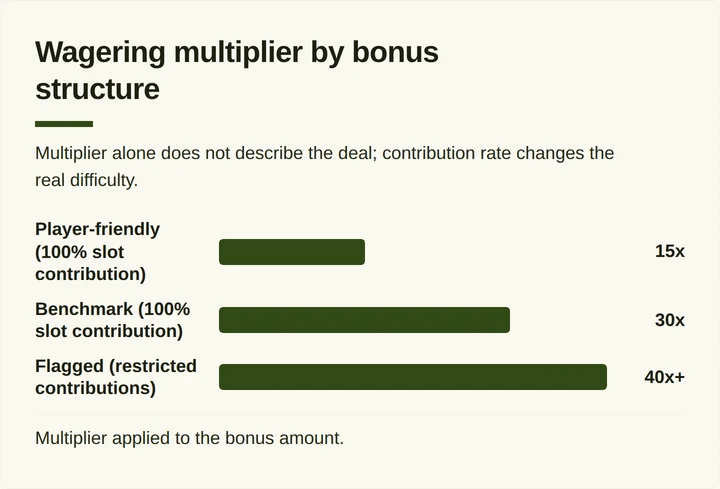
Wagering requirements are where bonus advertising and bonus reality diverge. Industry reviewers now treat a requirement at or below 30x the bonus amount as fair. Above 30x, particularly when combined with restricted game-type contributions, the structure is flagged as a red flag.
Some operators now offer 15x with 100% slot contribution, which is a materially different product from a 40x requirement where slots contribute 50% and table games contribute nothing. The multiplier alone does not describe the deal; the contribution table does.
| Structure | Multiplier | Slot contribution | Effective difficulty |
| Player-friendly | 15x | 100% | Low |
| Benchmark | 30x | 100% | Moderate |
| Flagged | Above 30x | Restricted by game type | High |
The mechanism behind contribution weighting is straightforward. Each game type contributes a percentage of every wager toward clearing the requirement. Slots at 100% clear at face value. A 50% contribution means double the wagering to reach the same total. Restricted game types contribute nothing, so play on them extends the clock without reducing the balance.
The headline percentage alone is close to meaningless as a player metric. A 200% match at 40x with restricted contributions can cost more to clear than a 100% match at 15x with full slot weighting. The multiplier and the contribution table together determine the true cost of the bonus.
Payment rails: Interac timing and limits
Deposit speed and withdrawal speed are separate problems, and platforms rarely advertise the second one clearly. On the deposit side, Interac transactions typically post within 15 to 30 minutes and often instantly. Interac Online, the direct bank payment method, is generally faster than e-Transfer and usually completes in under 5 minutes. Withdrawals run on a different clock. Most operators take 1 to 3 business days to process an Interac e-Transfer withdrawal, and some quote up to 48 hours before the transfer is even sent. The delay sits with the operator’s internal review, not with Interac.
Limits vary by bank and by site. Most major Canadian banks cap daily Interac e-Transfers around C$3,000, though some Ontario-regulated casino sites accept per-transaction limits up to C$10,000 by combining Interac Online with e-Transfer rails. That range is illustrative rather than universal, so the operative number is the one in the operator’s own banking page.
Payment speed is a function of the platform model. An integrated operator controls its own withdrawal queue and can shorten it. A white-label site inherits whatever processing schedule the supplier runs, and the brand’s support team can explain the delay without shortening it.
Mobile experience: build type over screen size
Mobile quality is determined by build type. Three approaches are common. Native apps are distributed through app stores, progressive web apps run in the browser, and responsive browser builds need no install step at all. Native apps offer the tightest integration with device hardware and push notifications, but they face store review cycles and regional availability rules that can delay updates. Progressive web apps avoid the store entirely and update instantly, at the cost of some hardware access. Responsive browser builds are the lowest-friction option and the most dependent on connection quality. For live-dealer content, the constraint is bandwidth rather than interface design. A mobile build that performs well on slots can still stutter on live roulette over a weak connection. The relevant test measures how a live table holds up over a weak connection.
The term “mobile casino” describes three different technical products. The install step, the update path and the streaming behaviour all differ. None of them are visible from a screenshot of the lobby.
Customer support tiers
Support quality tracks the platform model as closely as payments do. Integrated operators typically run first-line support in-house with escalation paths into their own payments and compliance teams. White-label brands often run a thin front line over a supplier’s back office, which means the agent can log the issue but cannot see the withdrawal queue directly. Three specific gaps matter most:
- Whether support can action a withdrawal query or only forward it
- Whether live chat operates on the player’s time zone or the operator’s
- Whether complaints route to a regulator with jurisdiction over the licence
That third point matters most. In Ontario, the AGCO regulates licensed operators, so a complaint has a defined destination. On an offshore-licensed platform, the dispute route depends on the licensing authority, and the platform model determines which authority that is.
What the comparison actually resolves to
Platform model is the variable that explains most of the rest. It sets who holds the licence, who controls the withdrawal queue, how content reaches the lobby and how far a support agent can escalate without leaving the building.
The metrics worth checking are the ones with a mechanism behind them. A current RNG certification report, a published RTP per game, and a wagering multiplier paired with its contribution table all qualify, and a stated withdrawal processing window matters more here than a deposit speed. Ontario’s licensed layer had grown to 49 operators as of September 2026. Those operators run 84 approved websites between them, and that scale makes the underlying mechanisms more important to identify, not less.
FAQ
Does a bigger game library mean a better platform? No. Library size is often inflated through aggregation, and the same title can run at different RTP configurations on different sites. A published per-game RTP figure is a stronger signal than a total title count.
What wagering requirement counts as fair? Industry reviewers treat 30x the bonus amount or below as fair currently. Requirements above 30x combined with restricted game-type contributions are flagged as a red flag. Some operators now offer 15x with 100% slot contribution.
How long do Interac withdrawals take? Most operators take 1 to 3 business days to process an Interac e-Transfer withdrawal, with some quoting up to 48 hours before the transfer is sent. Deposits are faster, typically posting within 15 to 30 minutes or instantly.
What does eCOGRA certification actually verify? Two things matter. The RNG must pass statistical tests for uniform distribution and absence of pattern or bias, and the observed return over a large sample must match the advertised RTP. Monthly reports follow the initial certification.
Does GDPR specify which encryption a casino must use? No. GDPR Article 32 does not name a specific encryption algorithm or protocol; it requires appropriate technical and organisational measures, including the pseudonymisation and encryption of personal data, scaled to risk, the state of the art, and cost of implementation. Industry and regulatory-guidance consensus (not GDPR itself) treats TLS 1.2 as the current minimum acceptable protocol for encrypting personal and payment data in transit, with TLS 1.3 recommended for new deployments; data at rest is typically expected to use AES-256.