
Online Casino Industry Trends to Watch in 2025

Route recap
Six structural trends have reshaped the online casino industry. They include AI risk-scoring at the operator level, a licensing wall that keeps crypto-native casinos out of regulated markets, browser-based distribution that routes around app stores, live-dealer studios built for newly regulated jurisdictions, self-exclusion schemes shifting from voluntary to mandated, and provincial regulators separating their market operator from their enforcement arm. Each one changes who can operate, where, and under what conditions by altering how platforms operate and what players experience.
Artificial Intelligence and Personalization
The AI story in online gambling centers on behavioral risk-scoring. The concrete mechanism is a model that watches a defined set of player signals and fires an intervention when the pattern crosses a threshold.
Kindred Group’s Player Safety-Early Detection System (PS-EDS) is the clearest example of the operator-side version. The system tracks roughly 25 behavioral risk indicators, including loss-chasing, win-chasing, and shifts in deposit patterns, to flag at-risk players and trigger interventions. The number matters less than the architecture. A fixed indicator set means the model is auditable, and an auditable model is what a regulator can actually inspect. Kindred’s self-reported effectiveness figures are not independently audited, so the mechanism is the durable fact, separate from marketing claims attached to it.
The vendor-side version is Mindway AI’s GameScanner, a commercial tool for automated early detection of at-risk behavior. It reads session-frequency shifts and accelerated spending, and it is deployed across 60+ jurisdictions. Recent partnerships link Mindway to ATG, Sweden’s state betting company, and PrizePicks in the US market.
Compliance detection tooling can now be licensed from vendors. A mid-sized operator no longer needs to build its own detection stack; it can license one. That lowers the cost of entering a regulated market, but it also standardizes what “at-risk” means across dozens of operators at once.
Cryptocurrency and Blockchain Integration
Crypto deposits remain largely absent from regulated online casinos, and the reason is technical. Anti-money-laundering rules require a traceable link between the funds on the table and a real-world bank account. Crypto payments cannot provide that link by design.
The UK makes the constraint explicit. No UK Gambling Commission-licensed online casino accepts direct cryptocurrency deposits, because the licence conditions require a traceable source-of-funds chain that crypto rails cannot supply. Ontario reaches the same destination by a different route. The AGCO does not license standalone crypto-only online casinos, and the Registrar’s Standards impose KYC and AML requirements that in practice demand fiat-traceable payment rails, which bars crypto-native operators from the licensed market.
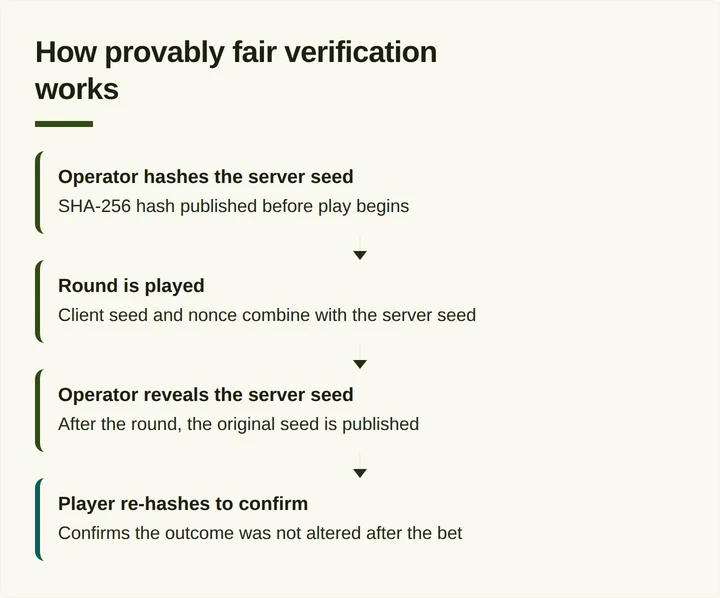
The one place blockchain does real work inside gambling is provably fair verification. The mechanism, often described in vague terms but concrete in practice, relies on three inputs: a server seed, a client seed, and a nonce. Before play, the operator hashes the server seed with SHA-256 and publishes the hash. After the round, the operator reveals the original server seed, and the player can re-hash it to confirm the outcome was not altered after the bet was placed. This is a genuine cryptographic commitment scheme based on mathematics, not marketing claims.
In regulated jurisdictions, crypto remains largely unavailable as a payment method due to compliance and AML requirements. In unregulated or crypto-native venues, provably fair verification gives players a real, checkable audit trail for game outcomes, but no licensing authority stands behind the operator if something else goes wrong. The two benefits do not currently coexist in the same product.
Mobile-First Gaming Experience
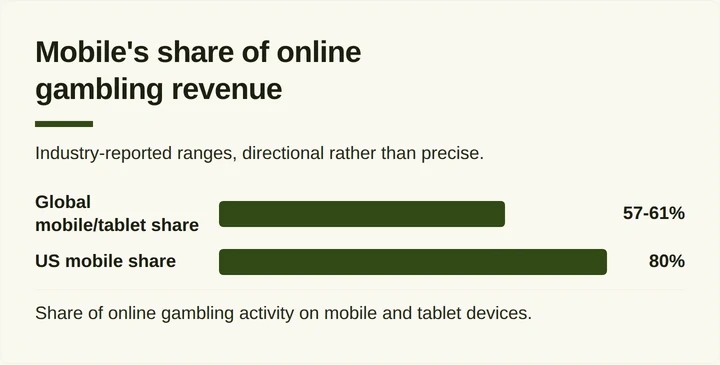
Mobile is the majority of online gambling. Mobile and tablet devices account for roughly 57-61% of global online gambling revenue. In the US, the mobile share of online gambling by device sits at approximately 80%. These are industry-reported ranges, estimates of scope and scale, but clearly established.
A Progressive Web App installs directly from the mobile browser via “Add to Home Screen,” bypassing the Apple App Store and Google Play entirely. That single architectural choice removes the app from app-store review and from those stores’ gambling-app policies entirely. For an operator, it means no review queue, no policy risk, and no store commission. For a regulator, it means the app-store gatekeeper is doing none of the compliance work.
Where the stores do apply, the rules are specific. Google Play permits real-money gambling apps only where the developer holds a valid government gambling licence for that jurisdiction. Such apps must be free to download, cannot use Google Play in-app billing to sell credit or currency, must be rated Adults Only, and must geofence unlicensed regions. Apple’s App Store Review Guidelines section 5.3 impose parallel conditions. Real-money gaming apps must be licensed for every location where they are used, geo-restricted to those locations, free on the App Store, and barred from using in-app purchase to buy credit or currency for real-money gaming.
The market splits into two channels. App stores and the PWA path now serve different operators. A licensed operator with a clean jurisdictional footprint can live inside the stores and accept their constraints. A PWA is not distributed through an app store, so it does not pass through that store’s review process and is not subject to its delisting decisions. The distribution channel has become both a compliance decision and a technical one.
Live Dealer Technology Advancement
Live dealer transitioned from differentiator to table stakes. The evidence lies in studio locations.
Evolution opened its first live-casino studio in Brazil, in Sao Paulo, becoming the country’s first licensed live-casino supplier on day one of the newly regulated online gaming framework. The company also signed a multi-year exclusive licensing deal with Hasbro covering live and slot titles. Opening a physical studio on day one of a new regulatory regime is a capital commitment that only makes sense if the supplier expects the jurisdiction to hold its shape.
Pragmatic Play made a comparable bet in Latin America. It opened a $15 million live-casino studio in Bogota, Colombia, with 100+ tables and Spanish- and Portuguese-speaking dealers. The studio shipped two new live titles: “Money Time,” a 54-segment wheel game show, and “Mega Roulette 3000,” with payouts reaching up to 3000x.
Live dealer is fundamentally a physical-infrastructure business wearing a software costume. A studio needs floor space, dealers, cameras, and a licensing presence in the jurisdiction it serves. That is why live dealer expansion tracks regulatory liberalization almost exactly. When Brazil opened its regulated framework, a studio appeared in Sao Paulo. When Colombia’s market matured, a $15 million facility appeared in Bogota.
For the player, live tables now run in local languages and time zones, one of the key features of trusted online casino platforms in newly regulated jurisdictions. Pragmatic Play’s Bogota studio put Spanish- and Portuguese-speaking dealers in the same hours their players keep. Barrier to entry in live dealer has shifted from code to capital, and the studios that can fund that buildout are the ones setting the terms in Brazil and Colombia.
Enhanced Responsible Gambling Tools
The shift toward mandated responsible-gambling infrastructure centers on self-exclusion, moving beyond voluntary-only tools.
GAMSTOP is the UK’s national online self-exclusion scheme, mandated under UK Gambling Commission licence conditions. A player registers once, and the exclusion applies across participating operators in one action. A five-year exclusion term is the most-selected option among registrants.
Ontario has been building toward the same architecture. iGaming Ontario has required AGCO-licensed operators to offer voluntary self-exclusion since the regulated market launched in 2022, and has been working toward a centralized tool that covers all licensed Ontario iGaming brands in a single registration. The direction mirrors the UK model. One registration achieves market-wide effect.
A third model runs through the operator. GameSense is the British Columbia Lottery Corporation’s responsible-gambling program, launched in 2009, which places trained GameSense Advisors at info centres in every BC casino and gaming centre. The brand is licensed to other jurisdictions, including Alberta’s AGLC.
For the player, the difference between centralized and per-operator schemes is decisive. A per-operator self-exclusion list can be defeated by opening an account at the next brand. A centralized scheme cannot. The regulatory trend points toward centralization, shifting self-exclusion into a market-level control applied across all licensed operators—the foundation of what makes online casinos protective by eliminating the per-operator loophole.

Regulatory Evolution and Compliance
The most consequential regulatory change was organizational rather than legislative, and it happened in Ontario.
iGaming Ontario became a fully independent standalone provincial agency, separate from its former parent regulator AGCO, on May 12, 2025 under the iGaming Ontario Act. The separation removed a parent-subsidiary conflict of interest that the Auditor General had flagged. AGCO remains Ontario’s primary gambling regulator, while iGaming Ontario handles operational management of the regulated market. The structural change matters. The body that runs the market is no longer nested inside the body that polices it.
Alberta has taken the legislative step toward a competitive market without yet operating one. The province passed enabling legislation for a regulated, competitive iGaming market open to multiple private operators, modeled on Ontario’s framework, with a launch planned for the following year overseen by the Alberta iGaming Corporation and regulated by AGLC. As of this writing, Alberta has passed legislation but remains in framework stage—the market is not yet live.
Quebec has maintained its position while other provinces moved. The province has not opened its online gambling market to private licensed operators. Loto-Quebec, the provincial Crown corporation, retains an online gambling monopoly through its Espacejeux platform and its Mise-o-jeu sports betting product.
Canada now runs three distinct regulatory models in parallel. Ontario has a competitive market with a separated operator and regulator. Alberta has legislated a competitive market on the Ontario model with a future launch target. Quebec maintains a Crown monopoly. For operators choosing where to apply, the three provinces represent different cost structures, different compliance regimes, and different timelines. For players, the practical outcome differs across provinces. Ontario and, prospectively, Alberta offer multiple licensed brands, while Quebec offers one.
Conclusion
Across all six trends, the online casino industry moved compliance from the product edges to core architecture. AI risk-scoring is now embedded in operator architecture—supplied by both proprietary operator systems like Kindred’s PS-EDS and vendor-licensed tools like Mindway’s GameScanner. Crypto is excluded from regulated markets by payment-rail requirements, a technical constraint rooted in AML compliance. PWA distribution routes around app-store compliance gatekeeping by design. Live dealer expansion follows regulatory liberalization because studios are physical assets. Self-exclusion is consolidating from per-brand tools into market-level schemes. Ontario’s regulator-operator split marks the clearest signal. Jurisdictions are rethinking who runs a market and who polices it.
For operators, market entry is now a regulatory-architecture decision above all else. For players, the differences between well-regulated and lightly-regulated markets are increasingly visible in concrete features. Self-exclusion either locks you out everywhere or doesn’t, game outcomes can be independently verified or not, and complaints have somewhere to go or they don’t. These distinctions will define the market as jurisdictions move toward full implementation.
FAQ
What is the biggest structural change in online casinos? The separation of market operation from market regulation, most clearly in Ontario, where iGaming Ontario became a standalone agency separate from AGCO on May 12, 2025. It removes a conflict of interest the Auditor General had flagged.
Why don’t regulated online casinos accept cryptocurrency? Because AML rules require a traceable link between funds and a real-world bank account, and crypto payments do not provide that link by design. No UK Gambling Commission-licensed casino takes direct crypto deposits, and Ontario’s AGCO does not license crypto-only operators.
What is a Progressive Web App, and why does it matter for casinos? A PWA installs directly from the mobile browser via “Add to Home Screen,” bypassing the Apple App Store and Google Play. That removes it from app-store review and from those stores’ gambling-app policies, which makes it a distribution workaround for operators whose licensing position is contested.
How does provably fair verification actually work? The operator hashes a server seed with SHA-256 and publishes the hash before play. After the round, it reveals the original server seed, and the player re-hashes it to confirm the outcome was not altered after the bet was placed. The client seed and a nonce complete the inputs.
Is Alberta’s competitive iGaming market live? No. Alberta passed enabling legislation for a regulated, competitive market modeled on Ontario’s framework, with a planned 2026 launch overseen by the Alberta iGaming Corporation and regulated by AGLC. As of this article, it remains a committed framework without a live operating market.
Does Quebec allow private online casino operators? No. Loto-Quebec retains an online gambling monopoly through its Espacejeux platform and Mise-o-jeu sports betting product, and the province has not opened the market to private licensed operators.
What is GAMSTOP? GAMSTOP is the UK’s national online self-exclusion scheme, mandated under UK Gambling Commission licence conditions. A player registers once and the exclusion applies across participating operators, with a five-year term being the most-selected option among registrants.
How much of online gambling happens on mobile? Mobile and tablet devices account for roughly 57-61% of global online gambling revenue, and in the US the mobile share of online gambling by device is approximately 80%. These figures represent industry-reported ranges.