
Key Features of Trusted Online Casino Platforms

Route recap
Trusted online casino platforms are defined less by what they advertise and more by which external bodies can shut them down, test their games, and force them to return a player’s money. A licence number, an RNG certificate, a PCI DSS attestation, and a connection to a national self-exclusion register are all third-party constraints. Marketing copy is not. When you evaluate a platform, you are really evaluating how many independent parties hold leverage over it.
That framing matters more now than it did a few years ago. European regulators have moved from issuing licences to operating shared infrastructure (central registers, mandated payment rails, standardized audit cycles), and the gap between a fully integrated operator and a Curacao-licensed shell has widened accordingly. The eight sections below walk through the mechanisms that produce that gap, one moving part at a time.
Licensing and Regulatory Oversight
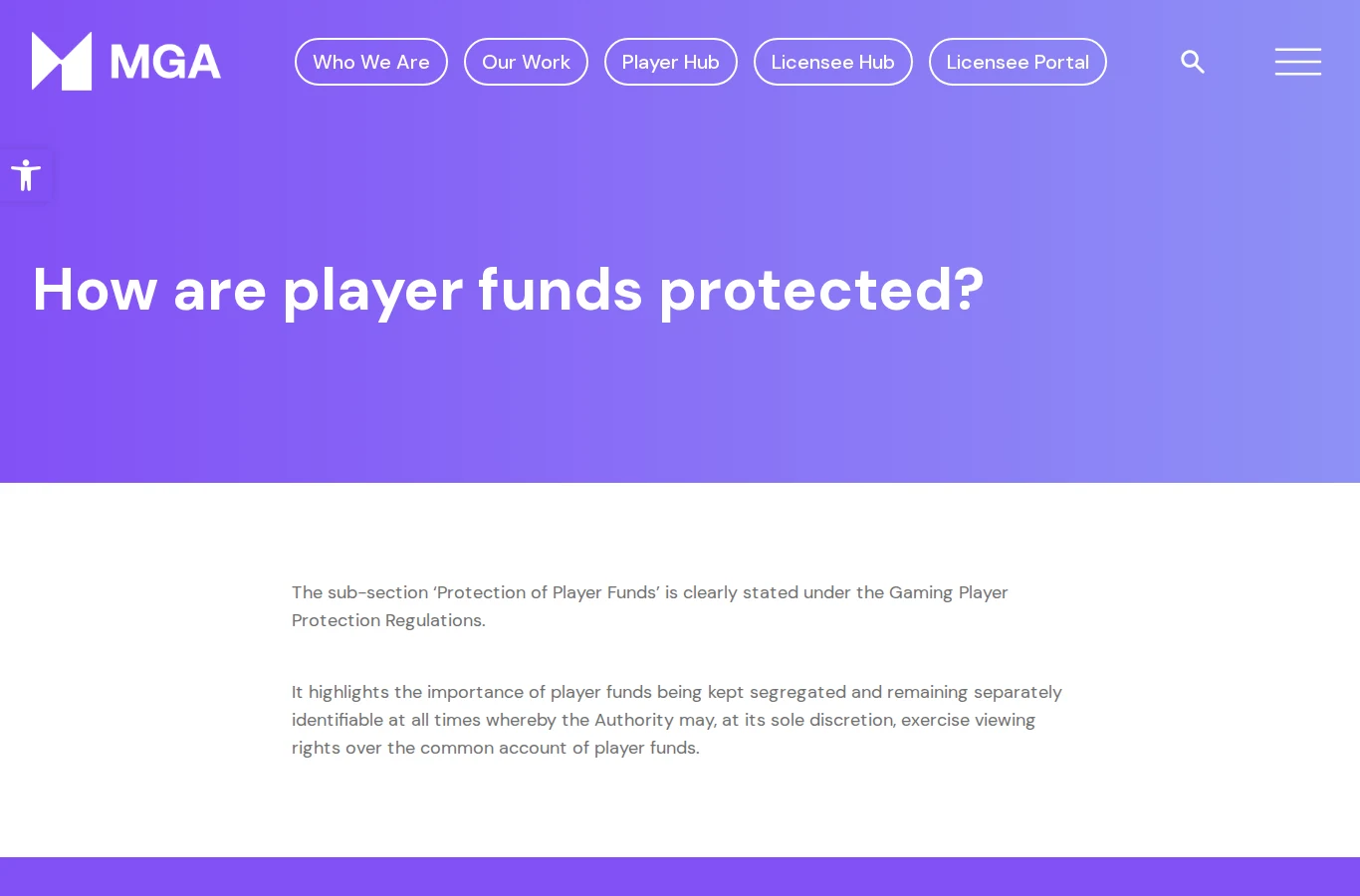
A licence is only as meaningful as the regulator behind it, and regulators differ enormously in what they actually require. The Malta Gaming Authority requires licensees to keep player funds segregated and separately identifiable at all times, with the Authority retaining the right to inspect the common player-funds account at its own discretion. That segregation requirement is the substantive part. If the operator becomes insolvent, segregated player balances are not available to general creditors.
The UK Gambling Commission takes a different route. It licenses operators serving British players and makes certified payment-processing systems and responsible-gambling tooling a condition of the licence itself, not a voluntary add-on. Fail either condition and the licence is at risk, which is why UK-facing operators tend to over-invest in compliance relative to their Curacao peers.
Smaller jurisdictions fill the rest of the market. The Kahnawake Gaming Commission, based in the Mohawk Territory of Kahnawake in Canada, licenses and regulates online gambling operators and requires licensees to meet its Internal Controls standards for internet casinos. Curacao eGaming issues licences under the Curacao licensing framework, which historically has been lighter-touch than the MGA or UKGC regimes. That is not automatically disqualifying. Many Curacao operators run clean books, but the compliance floor is lower, so the burden of verification shifts back onto the player.
The practical test is not “does it have a licence” but “which regulator, and what does that regulator actually enforce.” A licence number is a starting point for checking a public register, not a conclusion.
Certified Game Testing and RNG Verification
Game fairness on a licensed platform is not self-declared. It is certified by independent laboratories, and the certification is periodic rather than one-off. Gaming Laboratories International certifies the random number generators used by casino platforms, and certified operators are subject to re-testing on a recurring cycle, typically annual. A platform that passed GLI testing three years ago and has not been re-tested since is not currently certified in any meaningful sense.
GLI is one of three names you will see repeatedly. eCOGRA is an independent certification body that tests platforms against fairness, security, and responsible-gambling standards and issues its own seal to operators that pass. iTech Labs verifies the fairness of casino gaming systems alongside GLI and eCOGRA. The three overlap in scope but not in method, and a platform carrying two of the three is generally a stronger signal than one carrying a single seal from a lab you have never heard of.
Return to Player sits inside this layer, and it is widely misunderstood. RTP is the share of all wagered money a game is mathematically designed to pay back over the long run. It is not a short-term guarantee, and not a promise about your session. Certified slot games commonly publish RTPs in roughly the 94–98% range. That range is a typical industry figure rather than a universal constant; the exact number varies by game, by provider, and sometimes by the specific version of a game a platform chooses to run. A slot published at ninety-six percent on one operator and at the lower end of the range on another can be the same title with a different configuration.
What RTP does not tell you is variance. A high-RTP game with extreme volatility can wipe a bankroll faster than a lower-RTP game with tight variance. RTP is a long-run average, and long-run averages are cold comfort inside a single evening.
Secure Banking Infrastructure
Payment security on a licensed platform is a stack, not a single feature. At the transport layer, transactions are expected to run over TLS 1.2 or higher encryption, the same protocol your bank uses. At the data layer, operators handling card data are expected to meet PCI DSS requirements for payment-data security, which governs how card numbers are stored, transmitted, and access-controlled.
Those two requirements cover different failure modes. TLS protects data in transit; PCI DSS protects data at rest and limits who inside the organization can touch it. An operator that terminates TLS correctly but stores raw card numbers in an unencrypted database is still PCI-non-compliant, and that is the failure that actually produces breaches.
Segregated player accounts, covered in the licensing section, belong to this layer too. They are not a banking feature in the technical sense. Instead, they are an accounting and legal structure that determines whether your balance survives an operator insolvency. On a UKGC or MGA licence, segregation is typically mandatory. On lighter-touch licences, it may be optional or absent, which is one of the concrete reasons licence choice matters to a player’s money.
Two-factor authentication sits at the account layer. It is not regulator-mandated everywhere, but it is cheap, widely available, and the single highest-leverage account protection a player can enable. If a platform does not offer it, that tells you something about how the operator thinks about account security generally.
Transparent Terms and Conditions
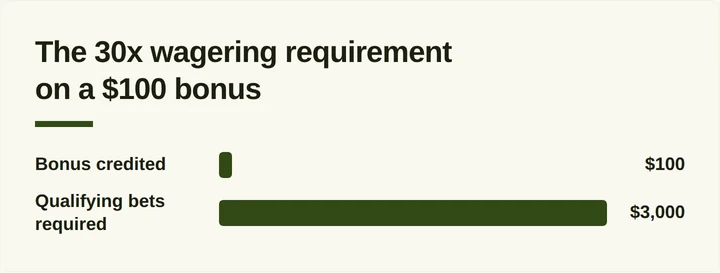
Bonus terms are where the arithmetic stops being abstract. A 30x wagering requirement on a $100 bonus means the player must place $3,000 in qualifying bets before the bonus becomes withdrawable. The multiplier applies to the bonus amount, not to the deposit, and not to the deposit-plus-bonus total. That is a generic illustrative example rather than any specific operator’s terms, but the mechanic is universal, and it is the single number most worth reading before accepting anything.
The multiplier is only the first variable. “Qualifying bets” is the second, and it is where most of the fine print lives. Many platforms exclude certain game categories from wagering contribution. Table games and live dealer titles frequently contribute at reduced rates or not at all, while slots usually contribute at 100%. A $3,000 requirement that only counts slot play is a very different obligation from a $3,000 requirement that counts everything. Bet-size caps are the third variable. Some terms void bonus eligibility if a single bet exceeds a stated threshold, which can quietly disqualify a player who never read that clause.
Expiration windows are the fourth. A wagering requirement that must be cleared in 7 days is materially harder than the same requirement spread over 30, and the difference is not always prominent in the marketing copy.
None of this is inherently predatory. Wagering requirements are how bonus economics work; a platform cannot hand out withdrawable cash without a mechanism to prevent immediate arbitrage. The question is whether the terms are stated plainly enough that a player can compute the obligation before opting in. If the multiplier, game contributions, bet caps, and expiry are all on one page in readable language, the operator is being straight. If any of the four is buried, that is the signal.
Responsible Gambling Implementation
Responsible gambling tooling splits into two categories. Tools the player controls belong to the first category, while infrastructure the regulator controls belongs to the second. The second category is where the meaningful recent change has happened.
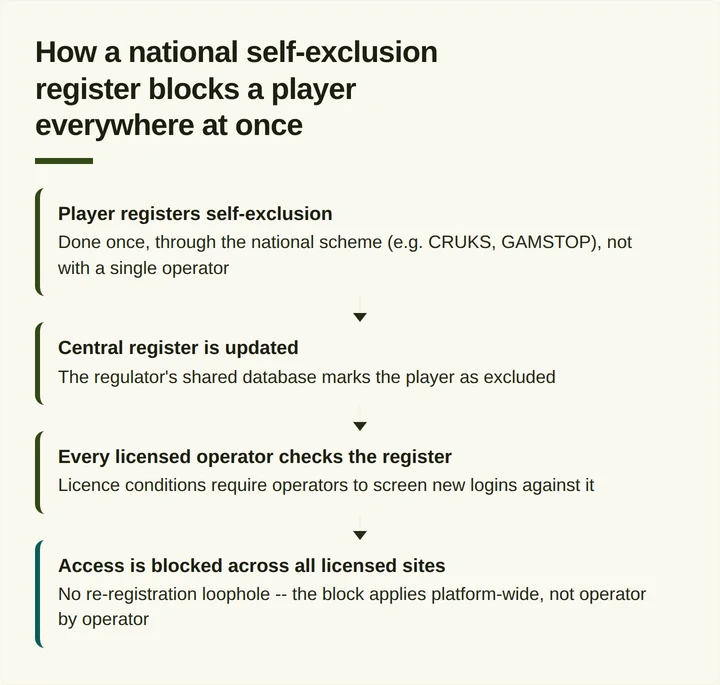
In the Netherlands, the regulator Kansspelautoriteit requires licensed operators to connect to CRUKS (the Centraal Register Uitsluiting Kansspelen), a centralized self-exclusion register. A player who self-excludes through CRUKS is blocked from every licensed Dutch operator at once, not just the one they registered with. That closes the loophole that made single-operator self-exclusion largely symbolic. A determined player could previously walk to a competitor and re-register within minutes.
The UK runs the equivalent system under the name GAMSTOP. A single registration blocks the player’s access across all UK-licensed online casinos simultaneously, for a period the player selects. Again, the mechanism is the point — the exclusion is enforced at the licensing layer, not at the operator’s discretion.
Player-controlled tools are the older half of the stack. Deposit limits let a player cap how much can be added to their account over a day, week, or month, independent of any self-exclusion status, and most regulators require operators to offer them. Reality checks (periodic on-screen reminders of elapsed session time or net spend) are required in a number of regulated markets, though the exact interval is not standardized across every jurisdiction, so the specific timing varies by regulator and operator rather than following a single universal rule.
The pattern across all of these is the same as in the licensing section. The tools that work are the ones enforced by an external party. A deposit limit a player sets and a platform honours is useful. A deposit limit the platform can quietly raise on request is theatre.
Professional Customer Support
Support quality is the least quantified of the features on this list, and it is worth being honest about why. Licensed platforms commonly offer customer support across multiple channels (live chat, email, and often phone), and 24/7 live-chat coverage is an industry norm rather than a universal regulatory mandate. No regulator publishes a response-time standard that every licensee must meet, so any specific minute figure you see quoted as a compliance requirement should be treated with suspicion.
What you can check is coverage and escalation. Does live chat operate around the clock, or only during business hours? Is there a documented escalation path for unresolved complaints, and does it terminate at the regulator rather than at the operator’s own appeals team? On UKGC and MGA licences, the answer is usually yes. The regulator maintains a complaints route for cases the operator fails to resolve. On lighter-touch licences, the terminal escalation point may be the operator itself, which is not really an escalation point at all.
Self-service resources matter more than they sound. A comprehensive FAQ, a payment-methods page with stated timeframes, and a bonus-terms explainer reduce the number of issues that need human support in the first place. An operator that has invested in those pages is usually an operator whose support queue is shorter and whose agents have more time per ticket.
Conclusion
The features that distinguish a trusted platform are almost all external constraints rather than internal virtues. A licence from a regulator with real enforcement power. An RNG certificate that is current rather than historical. PCI DSS compliance at the data layer, not just TLS at the transport layer. Bonus terms stated plainly enough to compute. A self-exclusion register that blocks the player everywhere, not just where they registered. Support that terminates at a regulator when it fails.
That reframing changes what a player should do. Instead of reading an operator’s marketing page and asking whether it sounds trustworthy, check the four things that are independently verifiable: which regulator issued the licence and whether the number appears in that regulator’s public register; which testing lab issued the RNG certificate and when it was last renewed; whether the bonus multiplier, game contributions, bet caps, and expiry are all stated on one page; and whether the platform is connected to a national self-exclusion scheme or only to its own internal one. Those four checks take less time than reading a review, and they produce a more reliable answer.
The market has moved in a direction that favours this approach. Regulators are building shared infrastructure, audit cycles are tightening, and the operators that cannot meet the new floor are being pushed toward lighter-touch jurisdictions. For a player, the practical consequence is that the licence name on the footer is now a much better predictor of everything else on this list than it used to be.
FAQ
How do I verify a casino licence is real?
Go to the regulator’s own website and search their public register for the licence number the operator displays. Do not rely on the operator’s own licence page as the source of truth. A real licence number will return a match on the regulator’s site, and a fabricated one will not. Cross-check the licensed entity name against the operator’s terms and conditions, since licences are issued to legal entities, not brand names.
What does RTP actually mean, and is a higher number always better?
RTP is the share of all wagered money a game is mathematically designed to pay back over the long run. Certified slots commonly publish figures in the 94–98% range. A higher number is better on average, but RTP says nothing about variance. A ninety-six percent game with extreme volatility can drain a bankroll faster than one at the lower end of the typical range with tight variance. Treat RTP as one input, not a verdict.
Why do licensed casinos require identity verification before a withdrawal?
Identity verification exists to prevent money laundering, underage gambling, and account fraud, and it is a condition of most licences rather than an operator preference. The practical effect for a player is that the verification step is unavoidable on a compliant platform, and the operators that skip it are usually the ones operating under weaker regulatory oversight.
What is the difference between a deposit limit and self-exclusion?
A deposit limit caps how much can be added to an account over a set period (day, week, or month) and can typically be adjusted by the player. Self-exclusion is a stronger measure. It blocks access to the platform entirely, and on national schemes like CRUKS in the Netherlands or GAMSTOP in the UK, it blocks access across every licensed operator in that jurisdiction at once.
Do all licensed casinos offer round-the-clock live chat support?
No. Multi-channel support (live chat, email, and often phone) is common across licensed platforms, and round-the-clock live-chat coverage is an industry norm rather than a universal regulatory requirement. No single regulator mandates a specific response-time standard across all licensees, so treat any exact minute figure quoted as a compliance requirement with caution.