
Key Features of Trusted Online Casino Platforms

Route recap
A trusted online casino platform is one that outside parties can test, inspect and shut down. The features that carry that weight are a licence you can verify on a public register, game software certified by an independent laboratory, payment handling built to card-industry standards, bonus terms you can calculate before you opt in, self-exclusion that reaches across a whole market, and support that escalates to a regulator when the operator stops answering. Everything on that list is checkable before you deposit, and none of it depends on what the homepage claims.
Ticketing for the Liechtenstein International Lottery in October 1994 is generally identified as the first online gambling venue open to the public. The pitch has not changed much since. What has changed is the machinery around the pitch, and the wider online casino industry trends to watch in 2025 show how much of that change now runs through compliance and payments.
Licensing and Regulatory Oversight
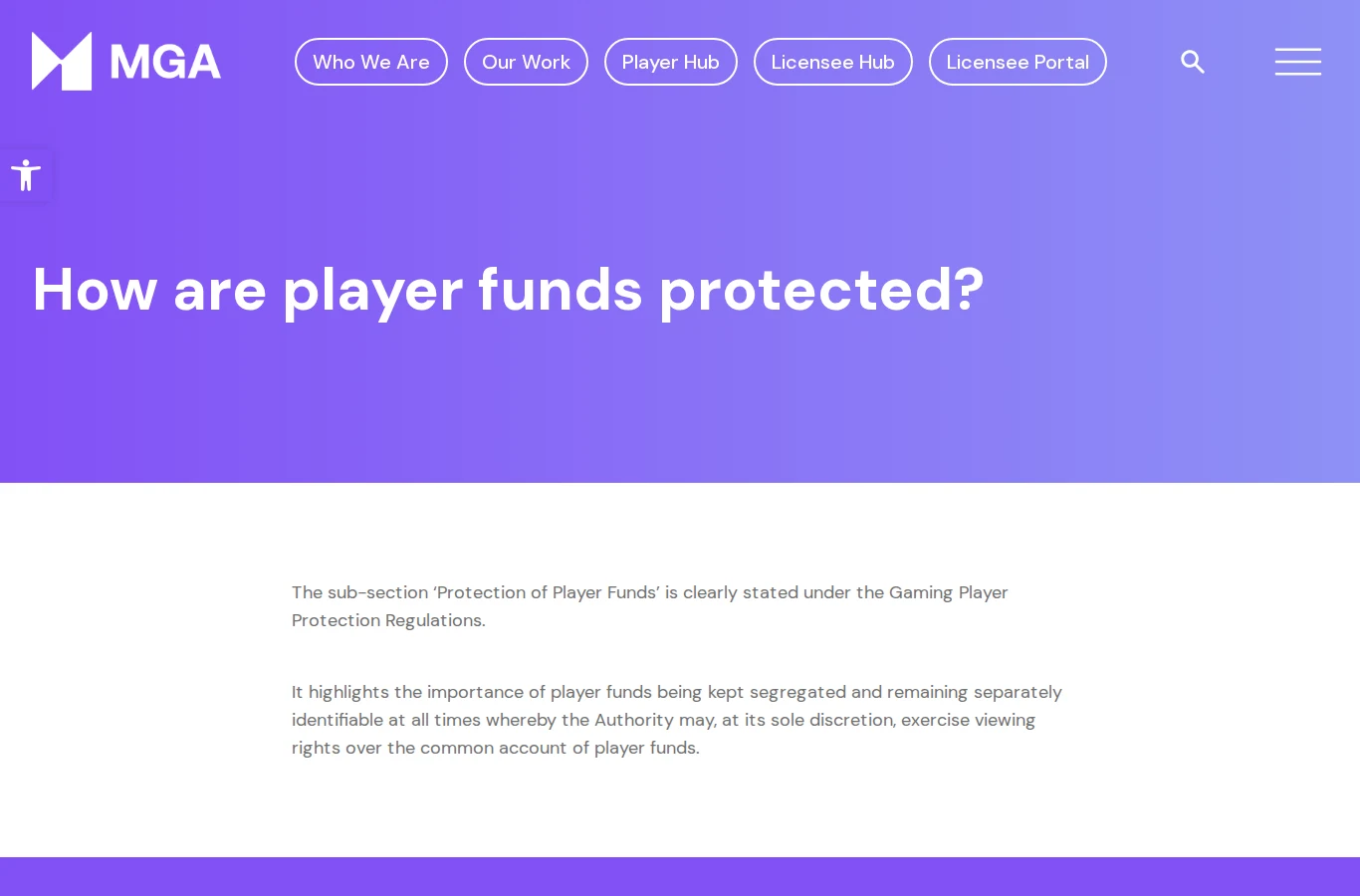
A licence matters because of the regulator behind it. Regulators differ in what they demand after a licence is issued as well as before it.
The Malta Gaming Authority requires its licensees to submit monthly reports no later than the 20th day of the following month. That deadline is useful to a player in an indirect way. It shows supervision that continues long after approval and runs on a calendar, which means there is a public record of an operator falling behind.
Different jurisdictions impose different terms. The Kahnawake Gaming Commission, established in 1996, issues gaming licences to many of the world’s online casinos and poker rooms, which is why that body’s name turns up on sites aimed at players far from Canada. Regulation is also not always permissive. Australia passed legislation on 28 June 2001 aimed at protecting Australians from gambling harm, a reminder that a jurisdiction can restrict a market as readily as it can license one.
The practical move is to skip the rankings and read the licence line in the footer, then find that exact name on the regulator’s own site. Licence checks are one part of a wider assessment, and what makes an online casino safe and reliable sets out the other parts.
Before you deposit, work through five steps:
- Find the licence holder’s registered name and licence number, usually in the site footer or on the about page.
- Search the regulator’s public register for that exact name, since trading names and licensed entities often differ.
- Confirm the licence covers the products you intend to use, because some licences are limited by game type.
- Read the regulator’s published licence conditions for the rules on how player money is handled.
- Save the regulator’s complaints route somewhere you can find it later.
A licence number is the start of a register search, not the end of one.
Certified Game Testing and RNG Verification
Fairness on a licensed platform is a claim backed by a certificate. The random number generator that drives slot results is tested by an independent laboratory, and the certificate carries a date and a stated scope. The date is the part worth reading first. A test result from several years ago describes software that may since have been replaced.
Three things get conflated in marketing. The first is RNG certification, which tests whether results are unpredictable. The second is RTP, the share of all wagered money a game is designed to pay back across the long run. The third is volatility, which describes how violently results swing around that average. They measure different things, and none of them predicts how a single session will go.
RTP is the one most often misread. A published RTP figure does not mean a player gets that share of a deposit back. It means that across an enormous number of spins the game’s maths returns that share of everything staked. In one evening the variance swamps the average completely, and a high-RTP game with wild swings can drain a balance faster than a steadier game with a lower published figure. The same title can also carry different published settings in different markets, so the help screen inside the game is the only reliable place to read the number that applies to you.
Against a market worth around $40 billion a year according to various estimates, a dated certificate from a named laboratory is a small piece of evidence that is hard to fake convincingly. Check the fairness page for the laboratory name and the certificate date. A player looking at a platform licensed in Malta or the United Kingdom can also ask support which laboratory signed the certificate and when, and a vague answer tells you plenty.
Secure Banking Infrastructure
Payment security is a stack of layers, and each layer fails in a different way.
At the transport layer, a deposit page should run over TLS, the encryption protocol behind the padlock in the address bar, which protects data while it travels. At the storage layer, an operator that keeps card details should be handling them under the card industry’s data security standard, which limits who inside the company can see a full card number. Those two protections cover separate failures. A site can encrypt the connection perfectly and still leave raw card numbers in an unencrypted database, and the second failure is the one that produces the breach stories.
Player balances are a third layer and a different kind of question. Where the platform holds your money, and whether the licence requires that money to be kept apart from company funds, determines what happens to your balance if the business fails. Ask support directly where player funds sit and whether the licence conditions require separation. A written answer that names the licence condition is worth more than a badge on the homepage.
Money also moves outward, and that shapes how closely a jurisdiction watches the operator. In Córdoba, licensed online gambling platforms must pay a monthly fee of 10% of gross proceeds to fund social programs. A market that takes a share of activity at that level has a standing financial interest in keeping its register accurate and its licensees solvent.
Two-factor authentication is the cheapest account protection available. Turn it on wherever the platform offers it, and treat its absence as information about how the operator thinks about account security more generally.
Transparent Terms and Conditions
Bonus terms are arithmetic, and arithmetic can be done before you accept anything.
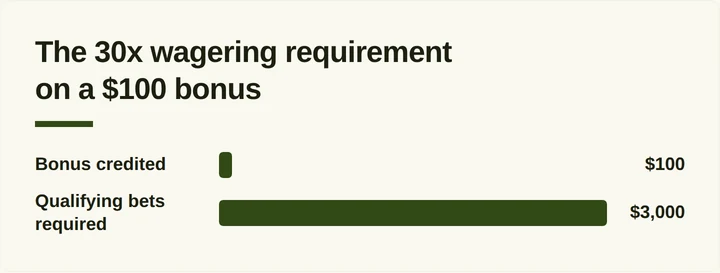
A wagering requirement is a multiplier applied to the bonus amount. Thirty times a small bonus is a large sum of qualifying bets, and that sum is what you have to turn over before anything becomes withdrawable. The multiplier is only the first variable.
The second is which games count. Terms frequently give slots full contribution and cut the contribution from table games and live dealer titles, sometimes to nothing at all. A requirement that only counts slot play is a far heavier obligation than the same headline number applied across every game. The third variable is a bet-size cap, which can void eligibility if a single stake goes above a stated limit. The fourth is the expiry window, and the same requirement packed into a short window is a different task from one spread over a longer period.
Public bodies publish at this level of detail as routine. The Gambling Commission publishes a pence-per-pound breakdown of National Lottery sales for the financial year 1 April 2025 to 31 March 2026, which is the kind of disclosure a player can reasonably expect from an operator’s bonus page.
Wagering requirements exist for a reason. No platform can hand out withdrawable cash without a mechanism that stops someone taking it immediately. The question is whether the four variables sit on one readable page. If the multiplier, the contributions, the bet cap and the expiry are all easy to find, the operator is being straight with you.
Responsible Gambling Implementation
Responsible gambling tools split into what a player controls and what a regulator enforces, and the enforced half is where the bigger structural changes sit.
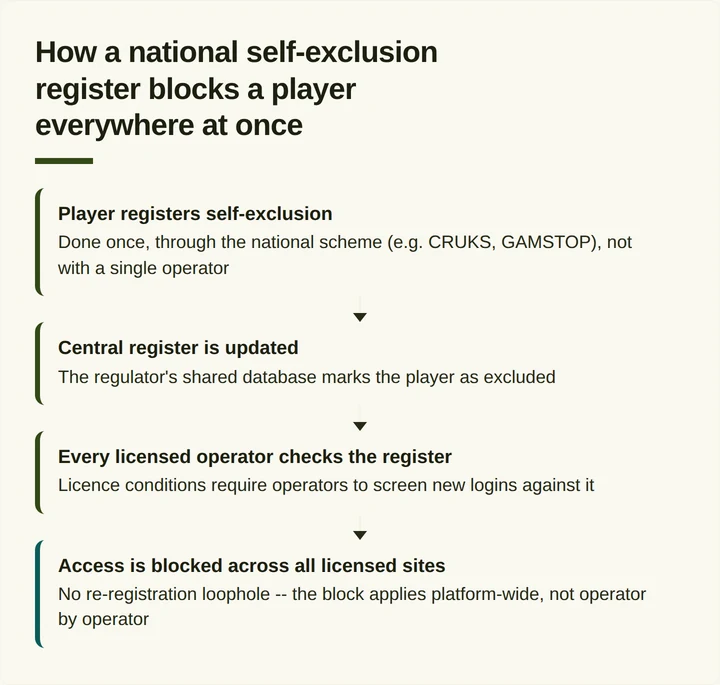
Where a market runs a central self-exclusion register, one registration blocks a player from every licensed operator in that market at once, for a period the player chooses. That closes the gap that made single-site self-exclusion close to symbolic, since a determined player could open an account with a competitor within minutes. The move from a site-level setting to a market-wide block is the part worth understanding before you rely on it, and how a central self-exclusion register works in practice explains the mechanism properly.
Deposit limits are the older, simpler control. A limit caps how much can be added to an account over a day, a week or a month, and it works whether or not the player is in any exclusion scheme. The test is whether the platform enforces the limit without negotiation when the player asks to raise it mid-session.
Outside help exists, it is free, and it is worth knowing before you need it. GamCare’s helpline advisers can be reached on 0808 8020 133, with support available 24/7. GambleAware offers a seven-question self-assessment for anyone who wants a structured look at how gambling is affecting them. Both services are independent of the casinos themselves, which is what makes them useful.
Professional Customer Support
Support is the least measurable feature on the list, and no single response-time standard applies across the whole market. What you can measure yourself is coverage, escalation and self-service.
Check whether live chat is staffed around the clock or only during office hours, and check it at an awkward hour before you need it. Look for a documented complaints process that terminates outside the company. On a licence with a published complaints route, the last appeal sits with the regulator, and that gives the operator a reason to settle early. On a lighter-touch licence the final appeal may land back with the operator’s own team.
Quality assurance is invisible until something goes wrong. GamCare call recordings and chat transcripts are saved for 28 days for quality assurance, and GamCare is available 24 hours a day, every day of the year, with callers able to contact the service for free. A helpline is a different kind of service from a casino desk, and the standard it meets is still a useful benchmark. Ask a casino’s support team whether it records and reviews interactions, and whether you can request a copy of your own.
Self-service material tells you how much the platform has thought about common problems. A payments page with stated timeframes, a bonus explainer with worked examples and a searchable help centre reduce the number of issues that need a human being at all.
Key Features of Trusted Online Casino Platforms FAQ
How do I check whether an online casino licence is genuine?
Find the licensed entity name and the licence number in the site footer, then search the regulator’s public register for that name. Trading names often differ from the name on the licence, so search the entity. If the register has no record of that name, the badge on the homepage proves nothing.
Does a high RTP make a slot safer to play?
RTP describes a long-run mathematical average across a very large number of spins, and it says nothing about what happens inside one session. A high-RTP game with high volatility can still empty a balance quickly. Read RTP and volatility together, and read the figure inside the game itself.
Are wagering requirements a warning sign on their own?
No. Bonus economics need a turnover mechanism, and a published multiplier is how that works. The warning sign is a set of terms where the multiplier, the game contributions, the bet cap or the expiry is hard to find or written in vague language.
What can I do if a platform refuses to pay out?
Start with the operator’s formal complaints procedure and keep a written record of every exchange. If that fails, use the complaints route published by the licensing regulator. A platform that holds a licence from a body with a published escalation path has a reason to settle before a case reaches it.
Do self-exclusion registers work across every site?
They work across every operator licensed in the market that runs the register, which is the whole point of a central scheme. They do not automatically cover offshore sites or operators licensed somewhere else. If you want complete coverage, register with the scheme and also close accounts directly.